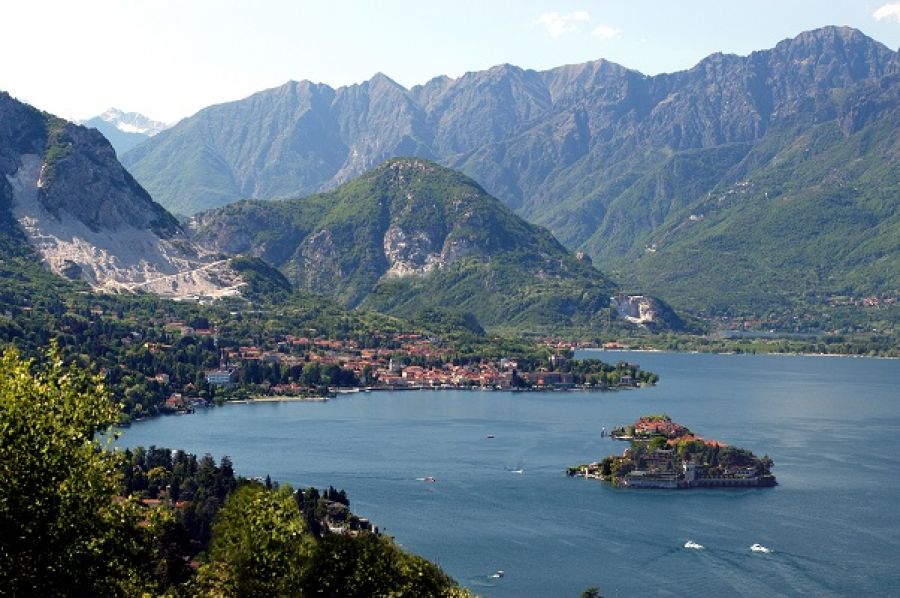
Baveno rises in a panoramic position in the center of Maggiore Lake, on the Borromean Gulf, facing the islands; Since the last century it has been a renowned place for accommodation and tourism, as evidenced by the splendid villas scattered throughout the area: Villa Henfrey (now Villa Branca), which hosted Queen Victoria of England and Villa Fedora where the musician Umberto Giordano stayed. The origins of the town are told by the Roman tombstones walled up on the facade of the Parish Church, dedicated to the S.S. Gervaso e Protaso, which stands in the center of the oldest inhabited area, on a plateau and preserves the beautiful 12th-century Romanesque façade intact. The monumental complex also includes the Baptistery of San Giovanni, of early Christian origins (fifth century), the Romanesque bell tower, the churchyard and the nineteenth-century Via Crucis. Place of extraction of pink granite, whose characteristics of particular value have made it the material for the construction of monuments of great importance in the past centuries in Milan, Rome, Paris, New York, Chicago and Bangkok. Its villages are enchanting and certainly deserve a walk: Romanesque, Roncaro and Loita lying on the hill offer breathtaking views of the lake, Oltrefiume has a characteristic historic center rich in history and Feriolo, an ancient fishing village, with its natural gulf and ‘extensive free sandy beach, it is an idyllic place.
Everything in Baveno leads back to granite and the workmanship of the stone-cutters: The quarrying and processing of local stone has profoundly influenced the character and the development of the Baveno area. From street names (which would translate from the Italian to things like “Quarry Street”, “Stone-cutters street”, “Pink granite Road”, etc) through to public, private and religious buildings but also in single monuments and artefacts, every corner shows signs of the presence of granite and of the activities of the people who were involved with it. Baveno pink granite is the most famous of the granites of the lakes (Maggiore, Orta and Mergozzo). Aimed to promote the knowledge of it Baveno works in collaboration with the Montorfano Granite Ecomuseum network, and has expanded its promotional activities to include the entire area surrounding Baveno, now part of the Sesia-Valgrande UNESCO Geopark.
GranUM Museum
The “Granum” Museum, located in the old Municipal Hall, is a multi-medial and multi-sensorial experience dedicated to the local Pink Granite and its historical and economic importance for Baveno. The museum also documents the variety of sites where granite is quarried and worked throughout the Verbano-Cusio-Ossola Province. The exhibition area is divided into 4 thematic sections: the pink granite and the variety of stones in the area; the mineralogical rarities discovered in the Baveno quarry; the work in the quarry and the processing of granite, both today and in the past; the history of quarrying here and how the granite has been used locally and abroad.
Piazza della Chiesa, 8 28831 Baveno
Info: 0323 924632 – info@bavenoturismo.it
MUSEUM OPENING TIMES:
From the 1st of October to the 31st of March From Monday to Saturday 10:30-12:30 Tuesday, Thursday, Friday 10:30-12:30 / 15:00-18:00
From the 1st of April to the 30th of September Every day 09:00-12:30 / 15:00-18:00
The Path of the Picasass
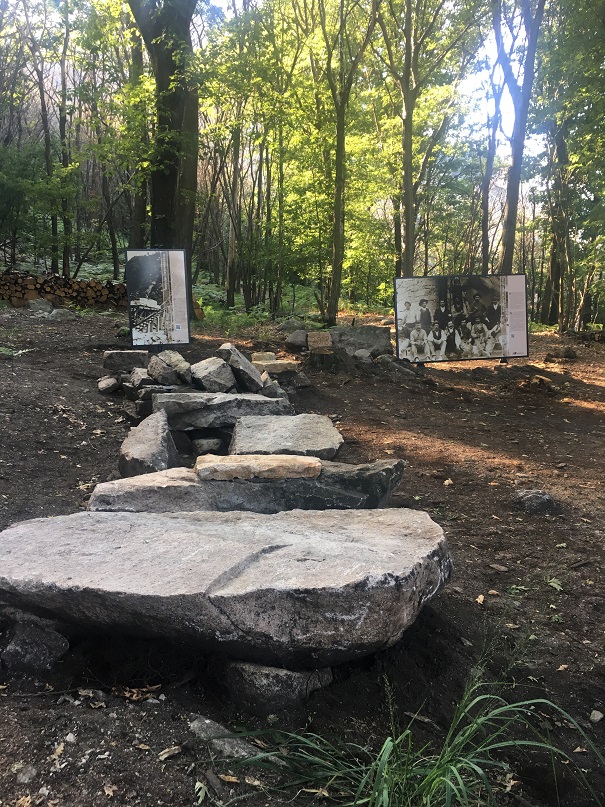
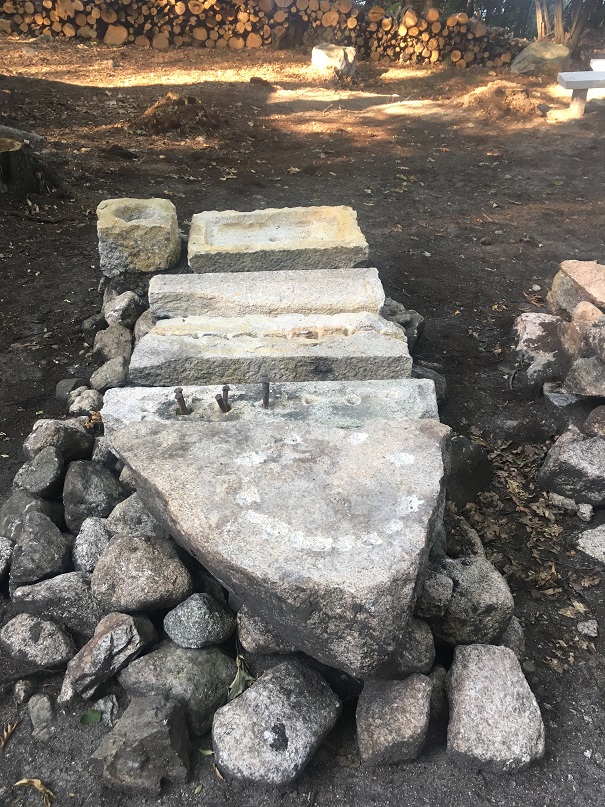
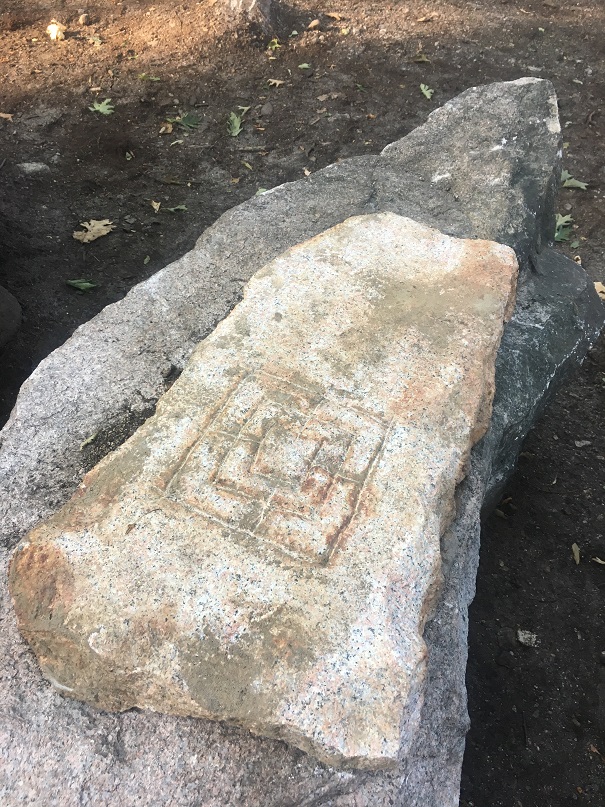
The most important extension of the open-air Museum is the path of the Picasass, so named because it was once used by quarry workers – called picasass in local dialect – to reach the Monte Camoscio excavation site. It now leads to a landscape installation displaying a series of stone blocks in various stages of manufacture, along with photographic panels showing work in the quarry. The footpath then forks, continuing in one direction up to the “Picasass” via ferrata, created by the C.A.I. (Italian Alpine Club) of Baveno, and in the other to the top of Monte Camoscio, where it links up with the marked route leading to the summit of Mottarone.
The granite
Granite is an intrusive magmatic rock formed over 280 million years ago: the name of the stone comes from the Latin “granum”, that is, made in “grains”. Granite is, in fact, composed of regular crystals formed as magma was slowly cooling down. In the province of Verbano Cusio Ossola, different types of granite outcrop in the area around Lake Maggiore, Mergozzo and Orta and are thus known as “Lake Granites”: the most famous of these is pink granite from Baveno, which is part of the summit of the mountain massif called Mottarone. In pink granite, 4 minerals can be found which give the fine grain that is so highly appreciated for building and ornamentation.
– orthoclase, white or pink in colour is the mineral which gives the typical colour to Baveno granite;
– plagioclase which is generally transparent or translucent;
– quartz, a vitreous and shiny mineral;
– biotite, one of the mica group of minerals which is a greeny-black colour.
Much of the mountain of Mottarone, as well as the nearby mountain of Montorfano, is also made up of another kind of granite, white granite. A vein of white granite crops out in the Cusio area with the now disused quarries at Alzo, Pella and Madonna del Sasso. To the West side of the mass of Montorfano, there is also an outcrop of greenish granite called “green granite of Mergozzo”, where the colour comes from a high level of chlorite.
Granite crystals
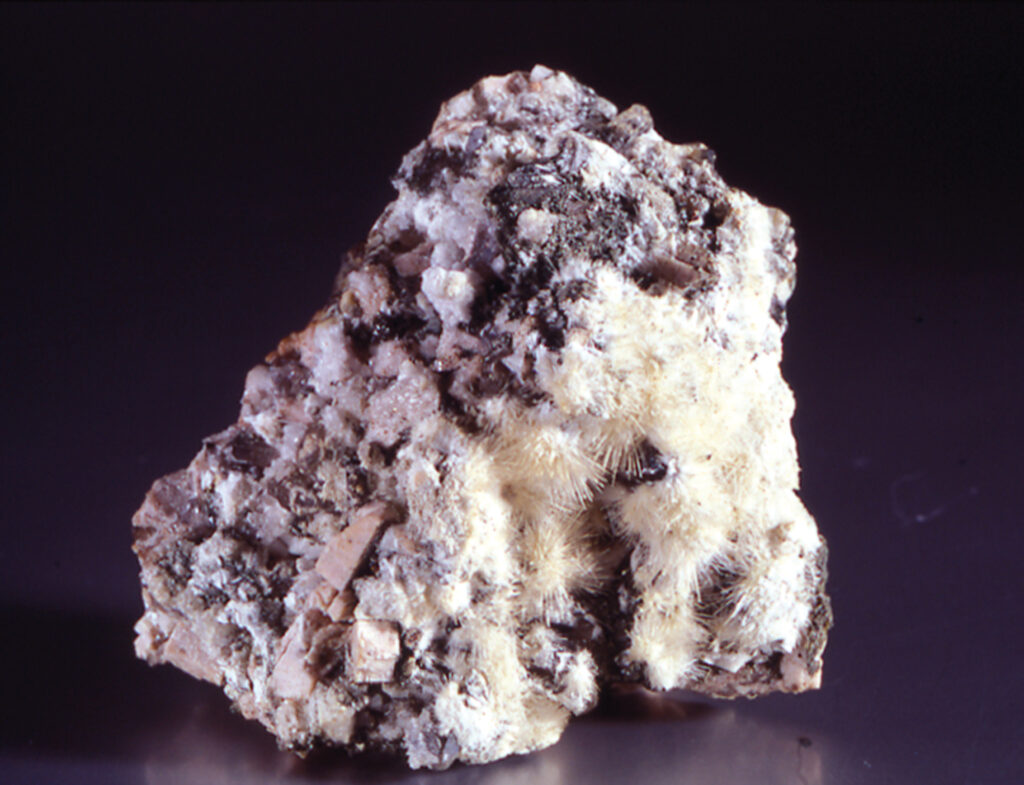
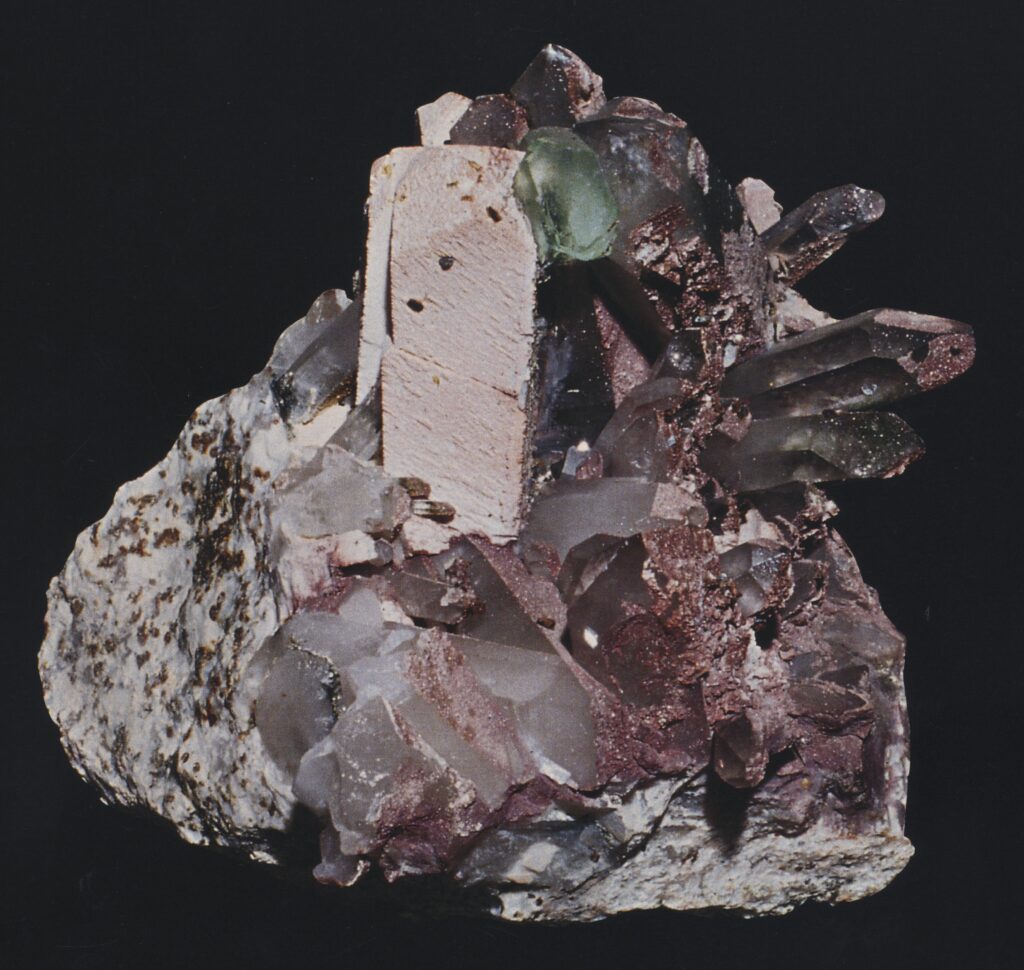
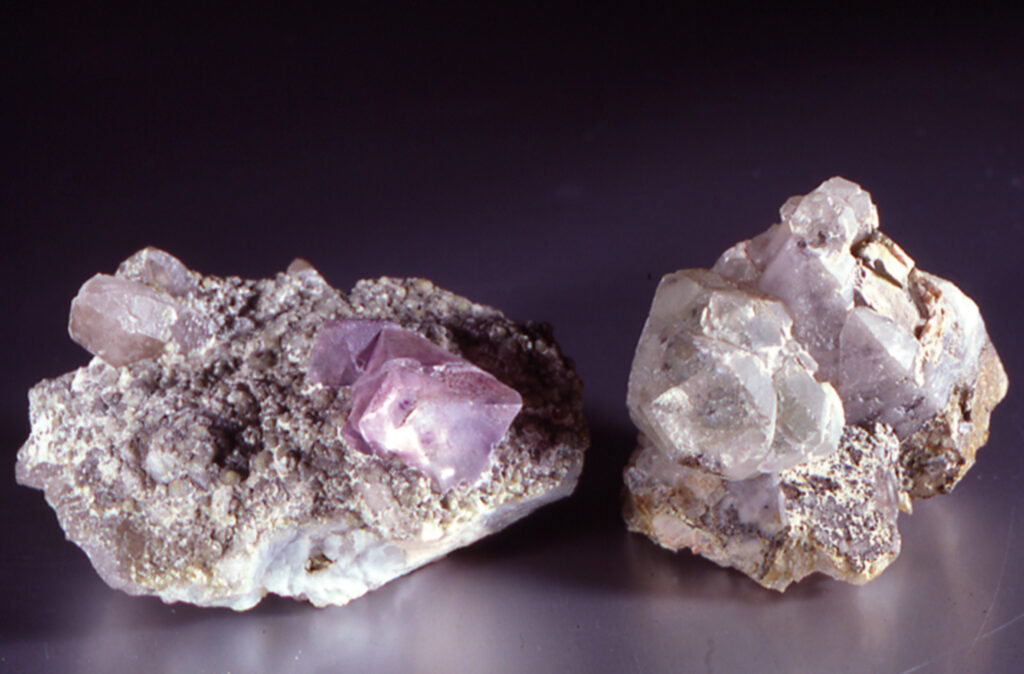
Baveno is well-known in the world of mineralogy, not just for its pink granite but also for some rarities found since the beginning of the 1700s during the process of quarrying. The best crystallizations are found in geodes cavities within the granite which formed inside the cooling magma, that are generally spherical and come in different sizes. Because of the extremely slow cooling process, various minerals were deposited in an orderly way to form crystals which developed on the internal walls of the cavities. The rarest and most precious minerals were discovered through microscope observation of the smallest cavities. In the Baveno quarries, over 60 different species of minerals have been found and these are considered to be true “mineralogical treasures” for their rarity, including Bavenite, an extremely rare mineral discovered for the very first time precisely in Baveno in 1901. Amongst the more “classic” crystals there are orthoclase, quartz and fluorite. Five of the nine scandium minerals known to date can be found in Baveno. In fact, four of these were discovered here for the very first time in the world. The most exceptional of is Bazzite, discovered in 1915, with its minute, pale blue, hexagonal crystals.
The beginnings
There are no certain dates as to when pink granite quarrying started in Baveno. Tradition narrates that St Charles Borromeo “discovered” the quarry quite by accident at the beginning of the 16th century. What is certain is that it is thanks to the Borromeo family, the feudal overlords of the territory, that Baveno granite began to be widely used in public and religious buildings of significant artistic prowess in Milan, such as the pillared portico of the Lazzaretto (1506), the Church of St. Fedele (1570), the Seminario Maggiore (1572) and the loggias of the Brera Palace. The relationship between Baveno and the Lombard capital of Milan became closer and closer, thanks to the waterways, ideal for transportation and already well-tested by Candoglia marble. The quarries were to be found, as they still are today, in what was known as the “angolo della voltata” (the “corner curve”) or, rather, the stretch of the Simplon road between Baveno and the hamlet of Feriolo which embraced the total environmental context of the slopes of Mount Camoscio and of the isolated step called Motto del Castello. Statistics from Baveno-based companies reveal a maximum of sixteen quarries open on the flanks of Mottarone.
The Eighteenth Century and Nicola Della Casa
The golden age of the Baveno “picasass” or stonemasons was the second half of the 19th Century and the beginning of the 20th Century with important dynasties of granite quarriers like the Adami, Bernasconi, Cirla, Della Casa, Galli, Polli and Tamini families. The merit of introducing industrial production methods and modern-style marketing techniques with exports all over Europe and to the Americas, goes to the businessmn Nicola Della Casa (1843-1894). The Della Casas began quarrying granite in Baveno in 1874 and, by 1879, their business had gained the honorary title of “premiata ditta” (award-winning company), with the distinction of the use of the royal coat of arms. Della Casa gained the “great diploma of honour” because he had been “the first in Italy to apply mechanization to granite quarrying”: he was, in fact, the first of the local entrepeneurs to introduce a steam boiler to shift the polishing lathes and he was among the first to experiment the use of mines in cavities. Della Casa also recognized the need to open-up markets at an international level, the importance of being able to speak foreign languages and the value of experimentation with new and constantly faster means of transport: all this led him to open offices in various capital cities in both Europe and America.
From the 1900s to the Present Day
In the 1900s, the Cirla Company took over from the Della Casa in the sales of granite around the world. They had been involved in the working of stone since the 17th Century and, in the 1860s, the Cirlas bought a few granite quarries in Baveno and on Montorfano Mergozzo), opening their business premises in Gravellona Toce. In 1883, the company began use mechanical lathes to produce columns for monuments and churches, including the celebrated quadriportico colonnades of the church of St- Paul-Outside-the-Walls in Rome, (1892-1928) and the column for the monument of Christopher Columbus in New York (1892). In the ensuing years, the business developed to include the supply of numerous monuments for Central and South America but also monuments in the Far East, such as the Royal Palace of Bangkok (1908-1913). After a pause due to the Second World War, the granite industry which, among other things was producing mill-wheels and bases for oil presses, found new energy in the high demand for thin granite sheets for countertops and other coverings. It is estimated that more than one million square metres of stone have been extracted from the Baveno granite quarries so far. Today quarrying continues in the Seula and Scala dei Ratti quarries, run since 1989 by the AGIFIN company. Besides the classic quarrying of ornamental stone, AGIFIN also has massive mining activity with the recovery of quarry waste from which feldspars are extracted to be used in the pottery industry or tha is used for concrete, asphalt, bituminous coating, railway ballast and different textures of gravel.
Granite in Art
Alongside the quarrying and processing of granite for the building sector and thanks to the high level of skill achieved by the “piccasass” or stonemasons, a field of production connected to the artistic working of granite and other types of stone developed. For example, a local Baveno man, Raffaele Polli, born in 1937, worked with his father and uncle in the family business which started in 1920 to create important monuments such as the statue of Winged Victory (“Vittoria Alata”) in the American Cemetery on the Via Cassia (1958) or the monument to the Normandy invasion at Colleville sur mer (1958). In this way, he learned his craft and he continued a path of personal artistic development that led him to create his own original works, sometimes with the help of his brother, Luigi. Examples in Baveno are the “Stonecutter’s Monument” and the “Crystallization of Granite”. Pink granite was also chosen by artists of international fame like Giò Pomodoro (19230-2002), who worked granite to create his sculpture “Ad Sidera” in the Taino park (VS) (1989). Panels of pink Baveno granite have also been used for the fountain created by the Swiss sculptor Dominique Appia for the Rolex headquarters in Geneva (1933). Today, the Baveno brothers, Marcello e Fortunato Marchi are active artisans in granite. One of their famous works is the sculpting of the Swiss artist Nancy Guggenheim’s creation for the Winter Olympic games at Pragelato in 2006.
IN BAVENO
Along the lakeside of Baveno the Stonecutter’s Monument made with pink granite by Raffaele Polli and in Matteotti Square the wall painting carried out in 1979 by Gilberto Carpo celebrate with different techniques the hard work of quarrymen. Churches and other religious buildings testify to the widespread and ancient use of Baveno granite for many different elements of construction. One of the most notable examples can be found in the 12 Tuscan order columns that make up the pillared portico of the Via Crucis (Stations of the Cross) in the courtyard of the church of Saints Gervasio and Protasio and in other architectural details around the splendid square. Since ancient times, granite has been used both in public and private buildings. In the old village centre of Baveno, called “Domo”, most of the houses, including some that date back to the late medieval period, have elements in granite. Outside the centre, the medieval watch-tower at Feriolo, which was part of the signal alert system of the Ossola Valley, is built entirely in pink granite. Later, from the 19th to the early 20th centuries, splendid villas were built with an intense use of this attractive pink granite for pillars, portals and other ornamental details.
IN ITALY AND ALL OVER THE WORLD
Baveno pink granite is the most famous of the granites of the lakes (Maggiore, Orta and Mergozzo) and is the most widely used within Italy and abroad: because of its specific qualities, it is preferred both as a building stone and for decoration: witness to this are the numerous works created from the beginning of the 16th century, initially just at a local level and in the neighbouring territory of Lombardy, then later in various regions of Central and Southern Italy. Baveno pink granite was first launched onto international markets thanks to Nicola Della Casa (1843-1894), an entrepreneur who used modern marketing techniques in several languages and who opened sales offices in all the major European capital cities and even in America. The good fortune of Baveno pink granite abroad continued throughout the 20th century with many works being created by the Polli family, sculptors in Baveno. In the 1900s, from the commercial point of view, it was above all the Cirla Company that developed an intense export business, selling granite all over the world including to the Far East.